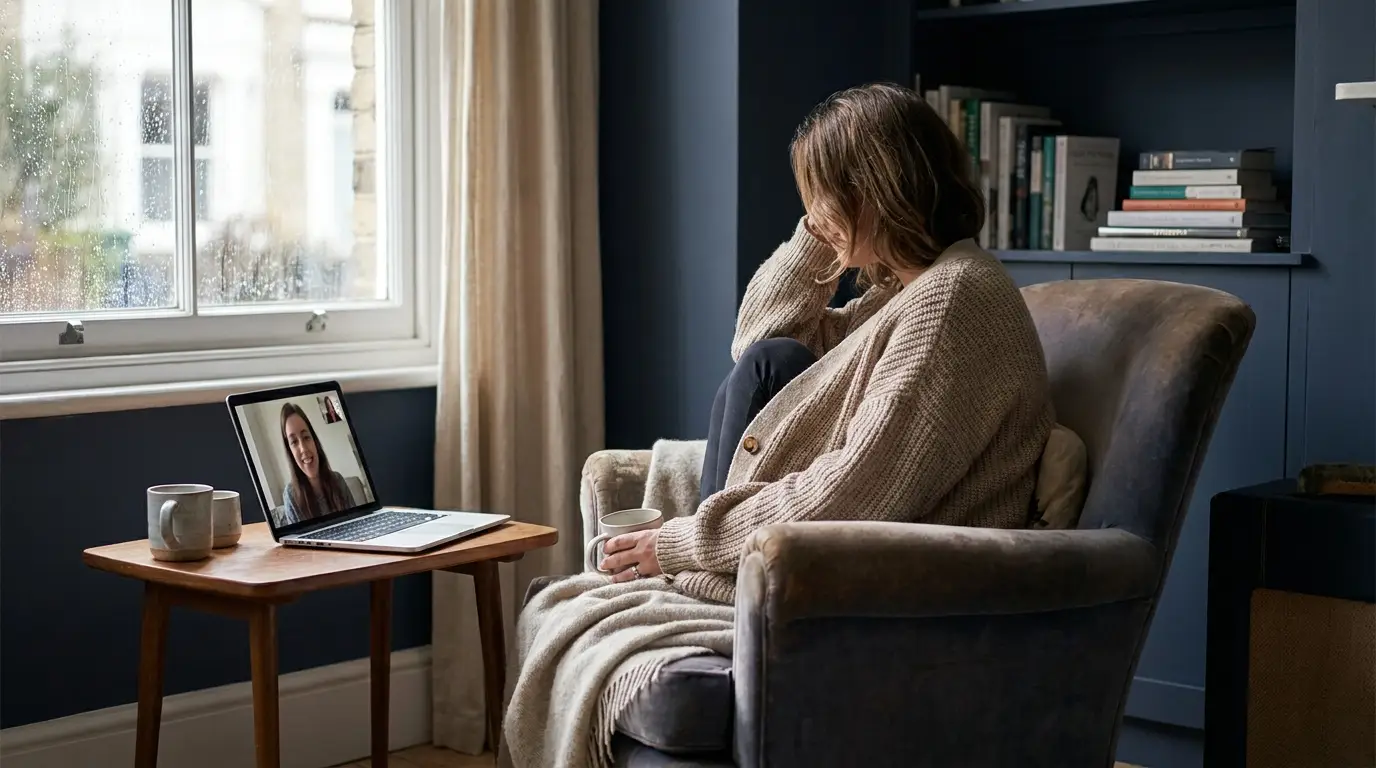
If you’ve never done therapy from your own living room — or never done it in the language you actually think in — it can feel uncertain. Does it really work over video? Which language should I pick? Let me tell you how bilingual telehealth therapy actually works, plainly.
Telehealth simply means meeting your therapist over secure video instead of in an office. For a lot of people it’s not a compromise — it’s the version of therapy they’ll actually keep showing up for.
Does virtual therapy really work?
Yes. For most common concerns — anxiety, depression, stress, life transitions, adjustment to a diagnosis — therapy delivered over video is as effective as meeting in person. What makes therapy work is the relationship, the consistency, and the skills you build. A screen doesn’t change any of that. What it does change is access.
The quiet power of the right language
Here’s something many bilingual people know in their body: there are feelings that only come out in your first language. The word that finally fits. The memory that lives in Spanish. The relief of not having to translate your own heart in real time.
Therapy works best when you don’t have to translate yourself to be understood.
In a bilingual practice you don’t have to choose once and stay there. You can do a whole session in Spanish, slip into English for a phrase that fits better, and move between them the way bilingual life actually happens — without losing a single nuance to translation.
What to expect — step by step
Before your first session
- You’ll receive a secure, private video link — no special software to master.
- Find a quiet, private spot where you won’t be interrupted: a room with a door, even your parked car.
- Headphones help with both privacy and focus.
- A stable internet connection and a charged device are all the tech you need.
During the session
- The first meeting is mostly conversation — your story, what brought you in, what you’re hoping for.
- Sessions usually run about 45–50 minutes.
- You and your therapist set the pace and the focus together, in the language that feels right that day.
Between sessions
- You may leave with a small practice or reflection to try.
- Consistency matters more than intensity — a steady weekly rhythm builds real momentum.
Is telehealth right for you?
Virtual therapy is an excellent fit if you have a busy schedule, limited transportation, health reasons to stay home, or simply feel safer opening up from your own space. It tends not to be the right fit for active crises or emergencies — those call for immediate, local, in-person care. If you’re ever in crisis, call or text 988 (the Suicide & Crisis Lifeline) or go to your nearest emergency room.
The short version
- Telehealth therapy is as effective as in-person for most everyday concerns.
- You need only a private space, a device, and a connection.
- Being able to speak your first language removes a hidden barrier to being understood.
- Consistency is what creates change — and telehealth makes consistency easier.
This article is for general educational purposes and does not constitute medical or psychological advice or a therapeutic relationship. If you are experiencing a mental health emergency, call or text 988 or go to your nearest emergency room.
← Back to all articles